November 2021
While the human population battles the COVID-19 pandemic, the rabbit population also struggles through its own Rabbit Hemorrhagic Disease (RHDV2) epidemic. This epidemic has not only impacted the wild rabbit populations, but also the domestic populations and has had many consequences and has set rabbit production back over the last year. Many fairgoers the past two years may have noticed a lack of bunnies to admire at county and state fairs across the United States because of RHDV2. As of November 2021, RHDV2 is confirmed in wild rabbits in over 11 Western states, including New Mexico. Mississippi, Minnesota, South Dakota, Georgia, and Florida all have confirmed cases of RHDV2 in domestic operations (Rabbit hemorrhagic disease…updates 2021). While humans quarantine against COVID, rabbit breeders are also quarantining their rabbits on much stricter protocols.
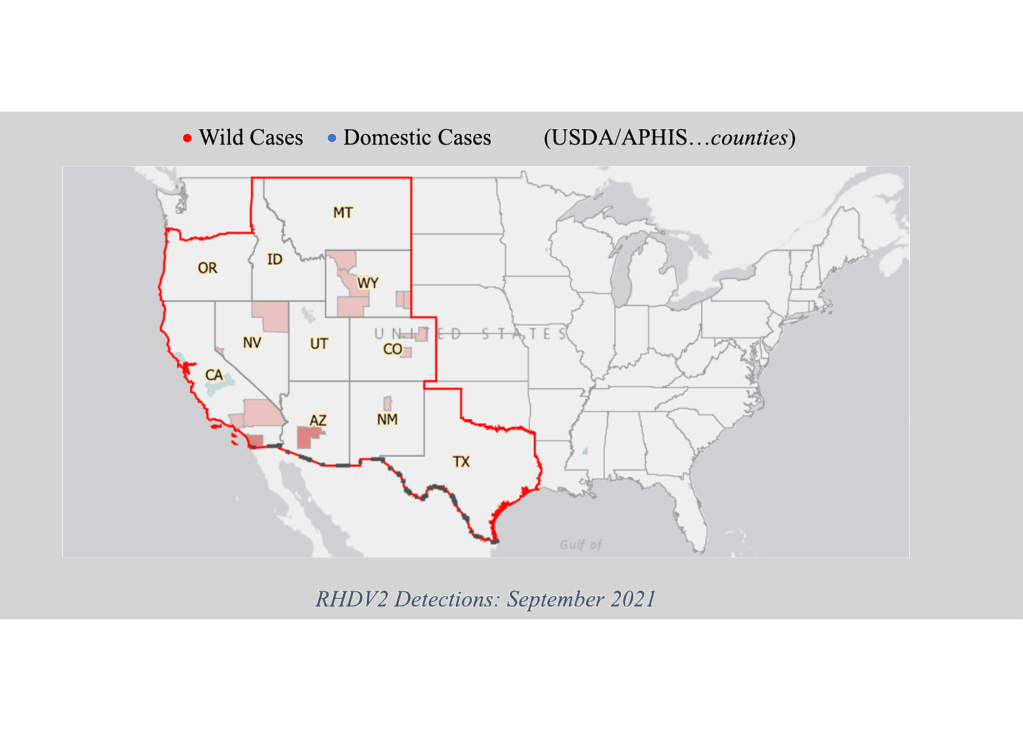
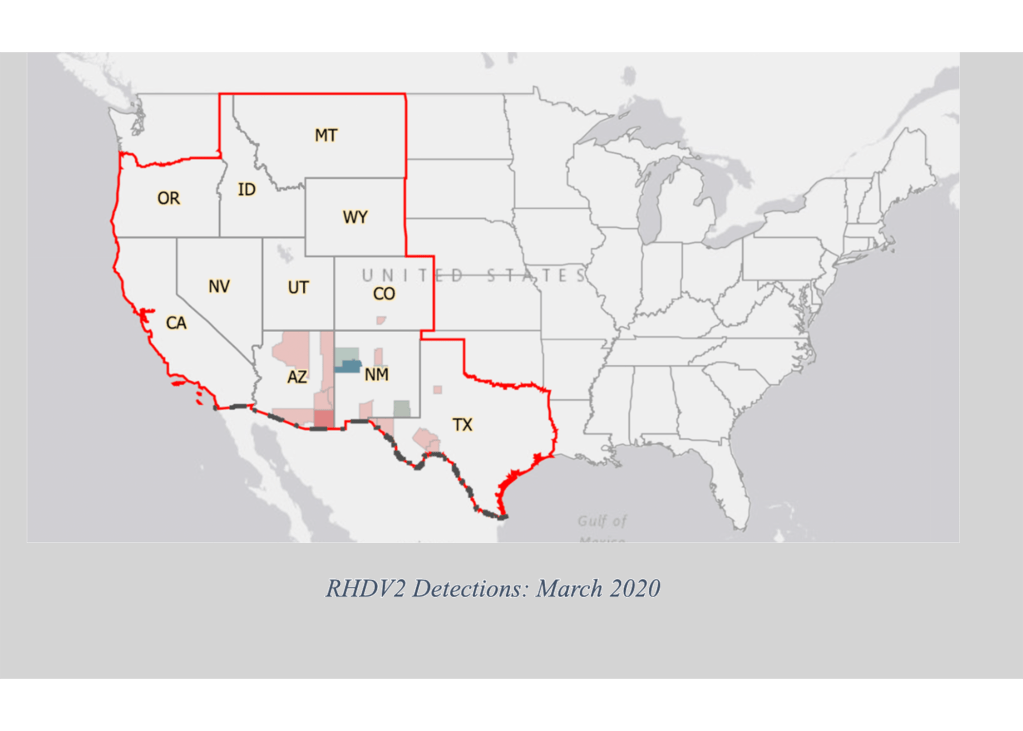
According to the United States Department of Agriculture (USDA) Animal and Plant Health and Inspection Service (APHIS) Rabbit Hemorrhagic Disease (RHD) is a fatal disease in rabbits that does not impact human health. The disease is resistant to both high and freezing temperature and can survive at least three months in a carcass or on a dried cloth. There is no cure, and the only solution provided to producers is isolation from healthy rabbits. In February of 2020, a second strain (RHDV2) was detected for the third time since 2018 in 11 domestic rabbits in New York City. In March, RHDV2 was detected in a rabbit in New Mexico, where the virus continued to spread across multiple states including Texas, California, Colorado, and Nevada. At this time, no vaccine was licensed in the U.S. forcing many producers to close their rabbitry doors and adhere to tough and strict biosecurity protocols. RHDV2 left producers unable to attain new rabbits for their herds, which had a severe impact on the way breeders produced meat, fiber, bred, and attended shows. Resulting in the cancellation of shows across the nation, which limited breeder interaction and breeder’s ability to include new and improved genetics into their herd. The USDA and APHIS do not report any significant trade impacts, but cite RHDV2 to impact the pet rabbit industry, 4-H/FFA/hobby groups, exhibitions, and laboratories; as well as then meat, pelt, and hunting sectors (USDA/APHIS, 2020).
Sherry and Albert Martin breed Netherland Dwarfs, Holland Lops, and English Angoras in Farmington, New Mexico for fiber and show. In June of 2020, their own herd fell under attack. They were forced to euthanize many of their beloved rabbits and lost many more to the virus. As news of outbreaks continued to spread throughout New Mexico, they practiced every biosecurity practice they could to prevent their own herd being infected. They suited up every feeding, didn’t allow any animals into their rabbitry, and didn’t travel and visit other rabbitries. Overall, most of their herd was lost. Sherry recalls this as “one of the worst things I’ve seen, my rabbits were dying everywhere and there was nothing we could do about it. It really broke my heart.” As longtime active volunteers for the local 4-H program, the lack of rabbits in the San Juan County Fair’s bunny barn in both 2020 and 2021 salted their wound even more. Albert recalls, “I know how much work my kids put into their rabbit projects, especially the market kids. They’re losing out on money opportunities and the ability to participate in their county fair. It really makes me sad for them.” For many kids, the market rabbit project is a way for them to get involved without needing the space for a steer or other large livestock species. They also get to earn money at auction, which many use to re-invest into their projects the following year, save for college, and invest in better equipment and genetics to improve their herd. The RHDV2 outbreaks consequently took those opportunities away from many 4-H/FFA rabbit exhibitors across the country, leaving some to heavily cull their herd or leave the profession completely. This became apparent as local rabbit 4-H project participants have declined over the past year, in San Juan County and other counties across the country (Martin, Sherry and Albert).
Vaccination against RHDV2 is an even bigger challenge. There are two vaccines available in Europe and can only be used in states with confirmed cases of RHDV2 and under the direction of State Animal Health Officials. Use of the vaccine also must be approved by the State Veterinarian. The two European vaccines are inactivated “killed” vaccines that consist of virus particles and other pathogens that have been grown and killed to mitigate disease production and have not been licensed in the United States and only authorized for emergency use (Emerging Risk Notice-USDA/APHIS). The lack of U.S licensure provides producers little to no information of effectiveness, length of immunity, and potential side effects for their herd, which creates a huge gamble for breeders who are wary of vaccinating their whole herd with a vaccine they know little about. Many states were able to offer vaccination clinics, but the vaccine and annual boosters can cost up to $35 each, which is a big hurdle for producers with large herds: 10 rabbits are a $350 vaccination bill (Martin, Albert and Sherry).
As RHDV2 can easily be transferred from wild to domestic herds and kill over 80 percent of infected rabbits and with rabbit hunting season approaching (early Nov.-late Feb.), hunters can play a huge role in preventing the spread of the virus. Georgia’s Wildlife Resources Division advises rabbit hunters with dogs to eliminate all contact between dogs and dead rabbits as well as applying a dry pet shampoo to dogs between hunts and between every new hunting area greater than five miles away. They also recommend wearing rubber gloves, deep burying/double bagging remains, cleaning tools and surfaces and clothing with detergent and a 10 percent bleach solution, and cooking meat thoroughly to at least 165℉ before consuming and feeding to dogs. As hunters encounter multiple (three or more) dead rabbits in a close proximity over a short time, deceased rabbits out in the open, and rabbits with blood around the nose and mouth; they are advised to contact local wildlife officials as soon as possible to report the potential outbreak (Guidance…participants, 2021). As of Nov. 2021, RHDV2 has been confirmed in wild rabbits in New Mexico, Arizona, Texas, Colorado, Nevada, Utah, Idaho, Wyoming, Montana, Oregon, and California; meaning hunters in these states need to take extra precaution on their hunts (Rabbit…current updates, 2021).
Other than 4-H and FFA member auctions, rabbits serve as an important economic role. According to the 2017 USDA Census of Agriculture, 4,186 operations sold over $9 million worth of live rabbits (USDA NASS, 2017 Census of Agriculture). Unlike their bovine counterparts, a single rabbit can produce more individual young more frequently throughout the year, are exempted from USDA slaughter exemptions, and gain more weight per pound of feed. Rabbit meat can also be a substitute for chicken, containing more Vitamin B12, Iron, Potassium, Magnesium, Phosphorus, and Zinc than chicken meat. Rabbit meat is also lower in fat and richer in protein (Yacoubian, 2021). However, a lack of commercial rabbit slaughterhouse facilities leads many away from butchering their own flock. This is also why rabbit meat is not found in many common grocery stores and is most often bought and sold on a private basis.
Uniquely, rabbits can also be bred for their hair. Sherry Martin has a passion specifically for this market, breeding English Angora rabbits and gently pulling their loose fur and collecting it to create a variety of different products that she sells privately through her Facebook account. Her products range from clothing to felt textiles to yarn that can be sold by the skein. She would also occasionally sell the raw hair for $10 an ounce. In comparison, raw sheep wool is sold by the pound anywhere between $6-$20 per pound. Sherry spent many hours maintaining her Angora rabbits to ensure their hair was top quality and clean and has many photos of her watching television and sitting on the living room sofa with an Angora in her lap and a comb in her hand. Angora fibers are the finest of all other animal fibers and create a very distinct and luxuriously soft feeling that is very sought after, creating a unique market in the textiles industry. Commonly, the guard hairs are used for textile strength and aesthetics, while the finer hair is used to create warmth and softness (Mahapatra, 2021). Along with creating textiles, Sherry and Albert have both been very involved in educating people about rabbits and their production, and often volunteer their time and knowledge to do so; travelling around New Mexico and Colorado for shows and events that allow them to connect with people who may not know about raising rabbits. However, recent, and ongoing criticism of Angora breeders from animal rights activist groups has kept many in the dark afraid to be wrongfully accused of animal cruelty.
Small yet mighty, rabbits are a unique species that have potential to flourish in production if given the right attention and care. Rabbits not only impact our economy by millions of dollars but do so in through many different sectors such as meat and fiber. Research can and should be carried out to further investigate how rabbits impact the U.S. food and fiber market. The recent outbreaks of Rabbit Hemorrhagic Disease have had a largely negative effect on rabbit producers across the country, and the upcoming rabbit hunting season can help mitigate any additional serious outbreaks that consequently affect domestic herds.
References
Emerging risk notice – USDA aphis. RHDV2 Emerging Risk Notice . (2020, June). Retrieved November 20, 2021, from https://www.aphis.usda.gov/animal_health/downloads/rhdv2.pdf.
Guidance for rabbit hunters & field trial participants. (n.d.). Retrieved November 17, 2021, from https://gastateparks.org/sites/default/files/wrd/pdf/research/Guidance%20for%20Rabbit%20Hunters%20and%20Field%20Trial%20Participants%20RHDV.pdf.
Mahapatra, N. N. (2021, April 29). Clothing made from Rabbit Hair Fibre. TEXTILE VALUE CHAIN. Retrieved November 21, 2021, from https://textilevaluechain.in/news-insights/clothing-made-from-rabbit-hair-fibre/.
Martin, Albert and Sherry, personal communication
Rabbit Hemorrhagic Disease Factsheet. (2020, June). Retrieved November 16, 2021, from https://www.aphis.usda.gov/publications/animal_health/fs-rhdv2.pdf.
Rabbit hemorrhagic disease virus in the U.S.: Current updates 2021. Wildlife Health.org. (2021, November 3). Retrieved November 17, 2021, from https://wildlifehealth.org/rabbit-hemorrhagic-disease-virus/.
Rabbits. Agricultural Marketing Resource Center. (2017). Retrieved November 16, 2021, from https://www.agmrc.org/commodities-products/livestock/rabbits.
State of Texas: Texas Animal Health Commission. (2020). Rabbit health. Texas Animal Health Commission. Retrieved November 17, 2021, from https://www.tahc.texas.gov/animal_health/rabbits/.
USDA National Agricultural Statistics Service, 2017 Census of Agriculture. Complete data available at www.nass.usda.gov/AgCensus.
USDA/APHIS. (2020, June). Emerging risk notice – USDA aphis. Retrieved November 20, 2021, from https://www.aphis.usda.gov/animal_health/downloads/rhdv2.pdf.
Yacoubian, J. (2021, November 10). Rabbit meat vs chicken meat – health impact and nutrition comparison. Food Struct. Retrieved November 21, 2021, from https://foodstruct.com/compare/rabbit-meat-vs-chicken-meat.
 Online Portfolio
Leave a comment